


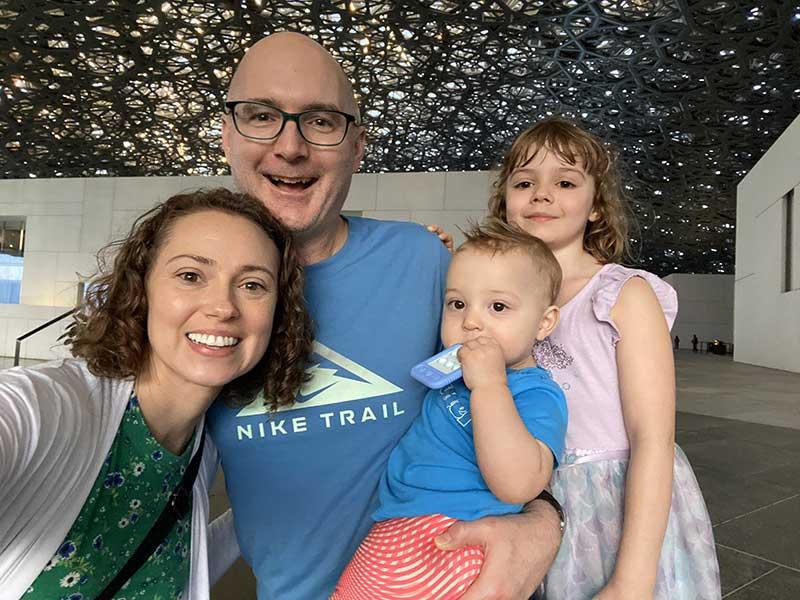
How a specialized heart team helped one mother safely grow her family
Emily Davenport thought having a second child was out of the question. During her first pregnancy in 2018, doctors discovered she had an enlarged heart, a condition that made another pregnancy potentially life-threatening. But five years later, with the support of the Penn State Health Cardio-Obstetrics Program, the Penn State biology professor safely welcomed a son, despite the extra workload placed on her heart.
“The program was just getting started at the time,” she said. “It was great because I could see both Cardiology and Maternal Fetal Medicine at the same time.”
Davenport learned of the program through Dr. Jason Fragin, a Penn State Health cardiologist in State College who took over her care when she returned to the states from overseas. Previously, she’d been living in Germany with her partner and completing the last year of her postdoctoral education when she had her first child. As an avid runner, she went into that pregnancy feeling like she was “totally healthy and in great shape.”
While most of her pregnancy proceeded as planned, during her last trimester her blood pressure shot up without explanation, and her baby’s growth slowed noticeably. Despite these dangers, her daughter arrived three weeks early in good health. Emily’s doctors suspected preeclampsia and expected her health would improve after her daughter’s birth, but her blood pressure remained high, requiring medication.
When everything changed
Four months later, after stopping the medication, Emily had a temporary stroke-like event that left her unable to move the left side of her body.
“It lasted about five minutes,” she remembered. “We called the paramedics, and by the time they arrived, I had regained the ability to move.”
While multiple tests found no clear cause for the attack or any lasting damage, they did reveal that Emily had an enlarged heart and an abnormal heart rhythm. Those findings led to a tentative diagnosis of peripartum cardiomyopathy – a type of heart failure that weakens the heart muscle toward the end of pregnancy and reduces its ability to pump blood – which was treated with medication.
After returning to the U.S., Emily transitioned her care to Dr. Fragin. Working closely with his colleagues at Penn State Heart and Vascular Institute in Hershey, he helped guide the next phase of her treatment. In 2020, the team decided to implant a pacemaker to control her heart rhythm.
“After I got my pacemaker, I felt so much better,” she said. “I had been so tired, but I thought that was just life as a new parent. It turns out I was really tired because my heart just wasn’t pumping very much.”
Experts on her side
With her condition stabilized, Emily put the idea of a second child on hold for several years. By 2023, however, after thoughtful conversations with her cardiologist and multiple second opinions, she felt confident she had the medical support needed to pursue another pregnancy. Around the same time, the Penn State Health Congenital Heart Center launched its Cardio-Obstetrics Program, bringing experts across multiple specialties together to help ensure safe pregnancies for women with heart disease and their babies.
“I decided it was a chance I could take,” Emily recalled. “Even if there’s a risk, I’ve got a whole team of people who are going to be watching me closely. If anything goes wrong, they’ll be able to catch it quickly.”
Throughout her pregnancy, Emily was closely followed through regular joint cardiac and obstetrics appointments with Dr. Amanda Cai and the Maternal Fetal Medicine team in Hershey, while continuing regular visits with Dr. Fragin in State College. During her first trimester, she experienced a drop in her heart’s pumping ability, but with careful monitoring it never developed into a serious issue.
At 37 weeks, signs that her baby’s growth had slowed prompted a carefully planned cesarian section.
“They were very thoughtful in how they did that, with a specific anesthesiologist and what seemed like 40 people in the delivery room,” she said. “They had control over everything.”
Following delivery, Emily spent the night recovering in the surgical intensive care unit, where specially trained nurses monitored her condition.
“Everything went smoothly,” she said. “There were no issues with my blood pressure rising. They kept a very close eye on medications and everything else. I had really great care.”
Two years later, Emily is thankful she has two healthy children and the ability to live her life without restrictions.
“I feel incredibly fortunate. I'm walking around healthy today, and my kids are thriving,” she said. “I’m constantly appreciative of it – every run I go on, every afternoon watching them play, even every diaper change. I never forget that all of this is possible because of the care I received."